
Earlier this year, we wrote about how AI search actually works and how to spot GEO snake oil. The question we get most often since then is simpler than any of that. How much business is actually coming from ChatGPT?
In October, three separate studies on AI search traffic were published in the same week. We then pulled our own clients’ analytics to see whether our numbers matched theirs. They all say the same thing. ChatGPT sends very little business compared with Google. Here are the figures, the one stat vendors will quote back at you, and the smartest argument on the other side.
There is one thing to say before the numbers. Every figure below counts clicks, meaning visits where the browser reported that the person came from ChatGPT. Clicks undercount AI’s influence, and we’ll get to why. The conversion numbers matter anyway, because a form fill or a phone call is a form fill or a phone call regardless of what the referrer said.
The numbers
Marie Haynes, an SEO consultant who has worked in the field since 2008, pulled 12 months of Google Analytics data from 100 websites, totaling about 145 million visits. ChatGPT sent 0.62% of the traffic that Google organic search sent. Add every other AI assistant, and the figure reaches 0.73%.
Growth in ChatGPT referrals stopped in August 2025 and has declined since. Early predictions that ChatGPT would overtake Google as a traffic source were wrong, and the people who made them have said so.
Conversions tell the same story. Of the 100 sites, 55 tracked conversions. Google organic produced 964 of them. Every AI assistant combined produced 36. That is 27 times as much business from Google as from all AI tools combined.
Two other datasets landed the same week. A UK agency’s AI referral benchmark found organic search delivering about 39 times the traffic and about 30 times the conversions of AI assistants. A separate 632-test study across 12 sites found no reliable link between how often a brand appeared in AI answers and any subsequent increase in branded searches or direct traffic. That second one was a one-month test on mostly B2B sites, so we’d call it suggestive rather than settled.
None of these publish full methodology, so treat them as samples rather than studies. The direction is the same in all three.
One more number from the Haynes sample is worth sitting with. Of the 100 sites, 45 tracked no conversions at all. If your site doesn’t track form submissions and phone calls, nothing else in this post is measurable for you. Fix that first.
What our own clients’ numbers say
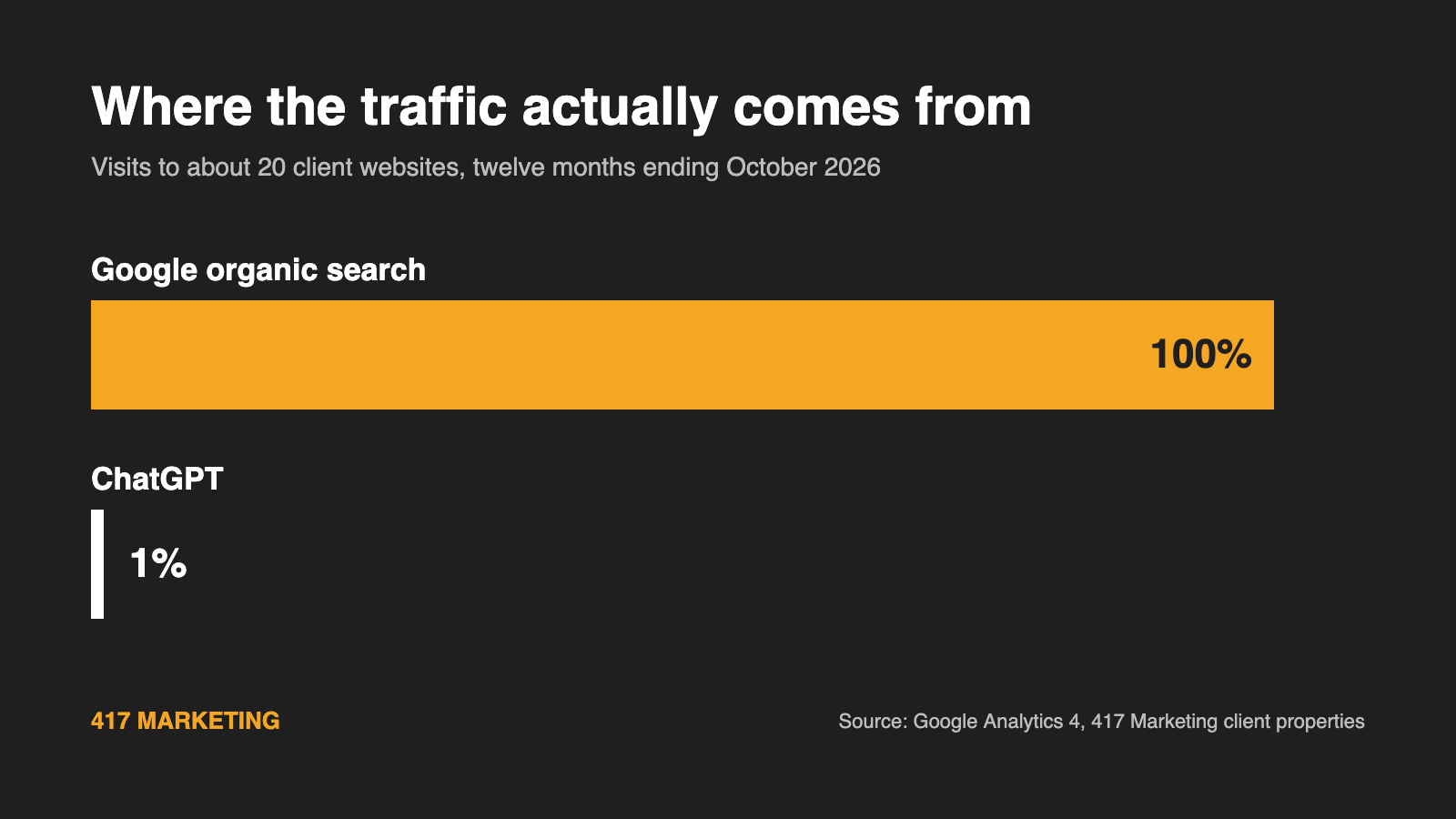
We ran the same check on a sample of about twenty of the client websites we manage, covering the twelve months ending October 2026. These are active clients whose analytics we could pull in one sitting, not a random sample. They are a mix of local businesses and B2B companies, with a few that sell nationally. One other caveat applies. Clicks from Google’s AI Overviews land in Google Analytics as ordinary Google organic traffic, so the Google side of these numbers already includes Google’s own AI search.
Across the whole group, Google organic search sent a little over half a million visits. ChatGPT sent about 5,500. That is 1.0%.
Conversions (what Google Analytics calls key events) came in at roughly 76,000 from Google organic and about 600 from ChatGPT, which is 0.8%. One site accounted for more than half of that conversion total, so we removed it and reran it. Google still produced about 60 conversions for every one ChatGPT produced.
The split between kinds of business matters. For local businesses, ChatGPT sent about half of one percent of what Google organic sent. For B2B and national companies, it was closer to 2.5%. No site in the group was above 7%, and most were under 1%.
We also didn’t see the conversion-rate advantage that gets quoted in the industry. Across our clients, ChatGPT visitors converted at about 11%, and Google organic visitors at about 14%. Conversion definitions vary from site to site, so don’t read too much into the exact figures. The point is that in our data, a ChatGPT visitor is roughly as valuable as a Google visitor, and there are a hundred times fewer of them.
The stat you’ll hear next
In the Haynes sample, visitors from ChatGPT converted at 13.8%. Visitors from Google organic converted at 3.02%. That is more than four times the rate, and it’s true in her data, even if it isn’t in ours.
It is also 36 conversions against 964.
A high conversion rate on a tiny base means the few people who click through from ChatGPT have already done their research inside the chat and arrive ready to act. That’s good. It argues for being findable, which is what SEO already does. It doesn’t argue for a separate retainer to chase a channel that produces three dozen leads across 55 websites in a year.
Google is the AI search that matters
Millions of people use AI search every day without ever leaving Google. AI Overviews and AI Mode both search Google’s own index and Google’s core ranking systems; by Google’s own description, they include several machine learning systems such as RankBrain, BERT, and neural matching. The AI Overview sits above the normal results. It doesn’t replace them, and not every search gets one.
So the AI search that sends people to businesses isn’t ChatGPT. It’s Google. Being findable there is still the whole game, and the work that gets you found there is the work that gets you named in an AI answer.
The smarter argument on the other side
The week after those numbers came out, the strongest response came from Mike King of iPullRank, an agency that sells AI search services. The argument goes like this. The numbers are right, but the category is wrong. Nobody judges a Super Bowl ad by its click-through rate. People form opinions and make decisions based on an AI answer without clicking anything, so AI search is a branding channel and should be budgeted and measured as such.
Some of that is true, and we’ll say so plainly. When Google shows an AI Overview, clicks on the regular results drop from 15% to 8%, according to Pew Research. ChatGPT mentions brands about three times as often as it links to them. A customer can read your name in an answer, call you an hour later, and show up in your analytics as “direct.” That is a real hole in attribution, and it sits alongside the holes SEO has always had.
Now, for the part where the argument breaks down. A Super Bowl ad is bought. Reach is guaranteed, and the creative is yours. Nobody can buy a place in an AI answer. The answer is assembled from pages that already rank, which means the only way in is the same way it has always been.
Follow the recommended work down one level and look at what it is. Keep accurate, consistent information about your business on every site a model might read. Earn mentions on sites people trust. Have pages that answer real questions well. That is SEO and reputation work under a different name. The only new spend in the pitch is a dashboard, and that dashboard is built by re-asking the same prompts on a schedule and counting mentions, because the AI platforms publish no official data.
The argument also can’t lose as written. Falling ChatGPT clicks get read as success, because better answers mean fewer clicks. Rising clicks would be success too. No result would ever count against it.
So in fairness, here is what would change our mind. If AI referrals reached even a tenth of Google organic conversions across our client book, or if we could show branded searches rising after a client started appearing in AI answers, with nothing else changing, we’d treat AI search as a channel worth its own line. Right now neither is close.
The people making the branding-channel argument also concede that the GEO hacks (schema tricks, robot-friendly formatting, and “write for prompts” advice) are a distraction. They also concede that nobody has shown the brand effect in actual analytics data. We agree on all of that. The disagreement is only about whether you should pay to measure mentions.
What this means if you’re a local business
The fact that customers find you and call without ever visiting your website is not new to you. That has been the Google map pack for a decade. The work that wins it is an accurate Google Business Profile, real reviews, a consistent name, address, and phone number everywhere, and a site that ranks. That is the same work that gets you named in an AI answer. You already know how to measure it, because you measure calls, forms, and branded searches.
In our data, ChatGPT sent local businesses about half of one percent of what Google sent. Google’s own results, the AI Overview and the map pack, are where your visibility actually lives.
What this means if you’re B2B or national
ChatGPT’s share of your traffic is higher. ChatGPT sent our B2B and national clients about 2.5% of what Google organic sent, and a few were over 5%. Our best guess is that B2B buyers do more research before making contact, and some of that research now runs through a chatbot that builds a shortlist. We haven’t tested that, so take it as a guess.
The work is still the same, with one difference in emphasis. You have no Google Business Profile, so the “accurate information everywhere” part means the directories, trade sites, and supplier databases a model reads when it builds that shortlist, plus your own product and capability pages answering the questions a buyer asks before they request a quote. Measure it with quote requests, demo requests, and branded searches. If you’re over 2% and climbing, keep an eye on it. At that level, it still doesn’t need its own budget.
What about AI agents that shop for you?
Google has announced a universal shopping cart, a commerce protocol with Shopify and Stripe, and a standard that lets AI agents use the forms and booking tools on your website. All of it is real. All of it is early, and almost all of it is built for e-commerce. The people promoting these standards themselves say it’s too soon for most businesses to build to them. We’ll revisit this when any of it produces a measurable order for a client.
Agents read the same pages people do. Being findable today is what puts you on an agent’s shortlist later. If someone offers you an “agentic readiness” package, that is the pitch to forward to us.
What to do
Make sure your site tracks the conversions that matter to you, which for most businesses means form submissions and phone calls. Keep doing the work that gets you found on Google, because that is where the AI answers come from. Watch your calls, forms, and branded searches, since some of the value of being named in an answer will show up there rather than as a click. If you ask an AI assistant what to do about AI search, it will probably give you a list: structured data, clear headings, consistent business listings, a site Bing has indexed. That is the SEO checklist with a new name, and it is already part of the work.
The channel is real. In our clients’ data, it’s about 1% of Google, and the work that wins it is the work you’re already doing. That is why we don’t sell an AI visibility service and aren’t adding one.
If a pitch lands in your inbox that you’re unsure about, send it to us. We’ll read it and give you our feedback.